Diamond guide
CUT
Diamonds are renowned for their immense brilliance – and, cut correctly, can sparkle even more brightly. Creating the optimal proportions and symmetry allows the light to be refracted within a stone more effectively and reflected back through the top. Making for a magnificent diamond that is even more radiant.
COLOR
Natural diamonds form from carbon deep beneath the Earth’s surface over millions of years. Other substances can become trapped within the diamondscrystals as they form – and this affects their color. A diamond’s color is thus essentially an indication of its purity: the more transparent and colorless a diamond is, the higher its quality. More light is able to pass through clear diamonds, allowing the light to better be dispersed – and a stone even more brilliant and sparkling. We use the GIA color scale developed by the Gemological Institute of America to measure our diamonds’ color. This scale ranges from D (colorless) to Z (light yellow or brown in color).
CLARITY
A diamond’s clarity is measured according to its internal characteristics. Most diamonds naturally contain tiny imperfections known as inclusions. The number, size, nature, location, and visibility of these inclusions determine the diamond’s grading on the clarity scale: the fewer and smaller the inclusions, the less likely it is that they’ll affect the passage of light. So the fewer imperfections a diamond has, the more valuable it is. Many inclusions are so small that a microscope – and an expert eye – are needed to spot them. I work with diamonds of higher clarity (IF-VS) and hand-select each to ensure the ultimate sparkle factor.
CARAT
A diamond’s weight is measured in carats (“ct” for short). This value varies depending on a diamond’s shape and type. While the carat value doesn’t always reflect a stone’s visual size, it does generally provide a good indication of a stone’s diameter.
HOW DO I CHOOSE THE RIGHT DIAMOND WEIGHT FOR MY ENGAGEMENT RING?
Young couples often choose diamond sizes around 0.30ct, 0.50ct, 0.75ct or 0.90ct. These diamond weights are wearable, comfortable, and perfectly suited for everyday wear. Of course, larger diamonds of 1ct, 2ct, 5ct or even over 10ct also exist. These diamonds are more commonly purchased as investments rather than for daily jewellery wear.
0.30 ct:
This is the smallest diamond size we recommend for a beautiful engagement ring. Extremely comfortable, ideal for everyday wear, and budget-friendly. A 0.30ct diamond has an average diameter of approximately 4.3 mm.
0.50 ct:
The perfect balance between price, quality and comfort. Large enough to be worn as a solitaire, while a halo setting can make the centre diamond appear visually larger. A 0.50ct diamond has an average diameter of approximately 5 mm.
0.75 ct:
Our best-selling diamond size. A 0.75ct diamond is large enough to shine beautifully as a solitaire. Prefer a halo design? Then you will have a truly stunning combination. A 0.75ct diamond has an average diameter of approximately 5.7 mm.
0.90 ct:
Very close to the American ideal of 1.00ct. Visually, a 0.90ct and a 1.00ct diamond are barely distinguishable, yet the price per carat is considerably more attractive. In relative terms, you pay significantly less for a 0.90ct diamond than for a 1ct diamond. A 0.90ct diamond has an average diameter of approximately 6.2 mm.
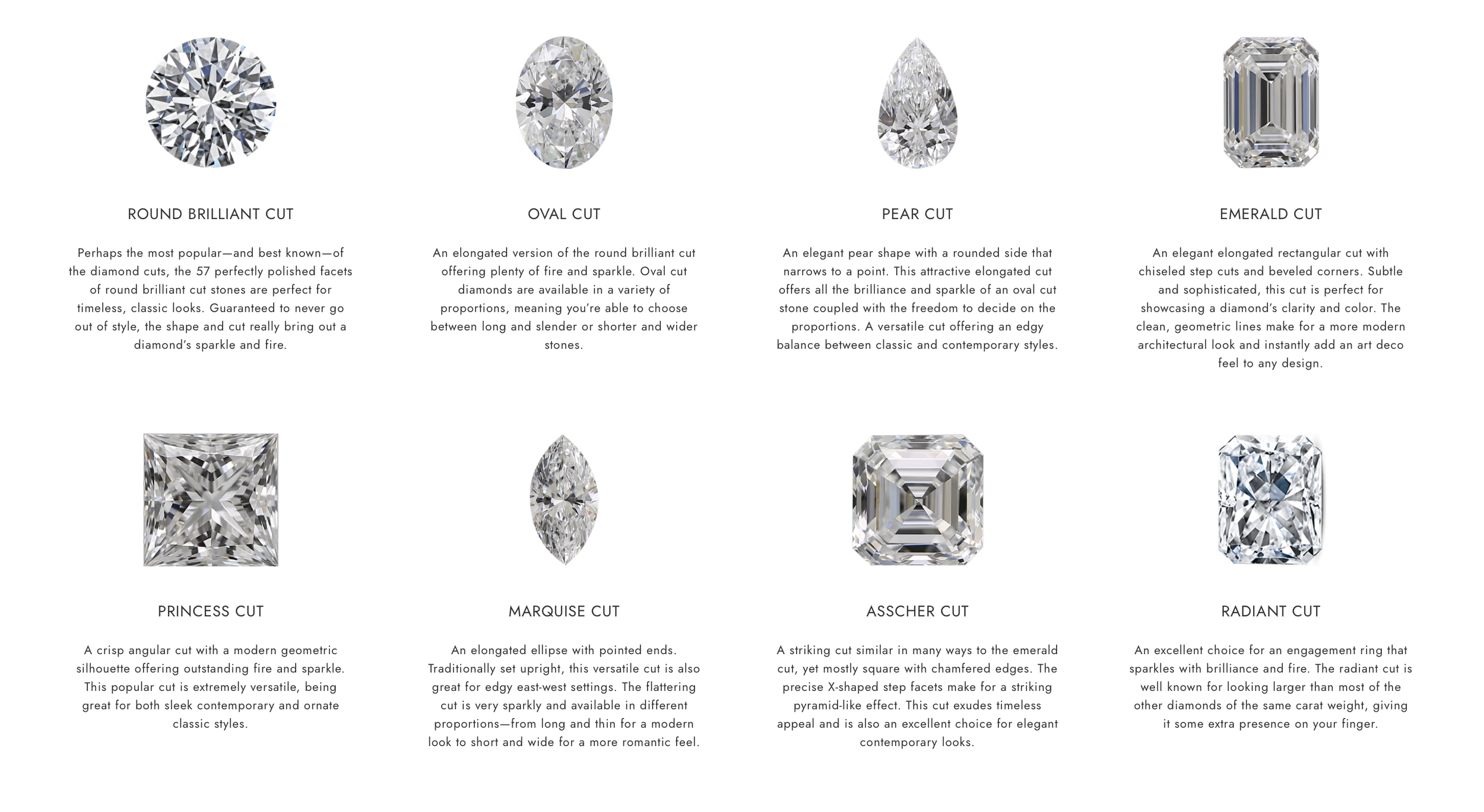
DIAMOND SHAPES